

Kirk Franklin Prayed With Chris Brown. We Can Do Better
Author: Sierra Lyons
If your social media timelines look anything like mine, you’ve likely seen a video of Rep. Jasmine Crockett presenting Chris Brown with a Congressional Record recognition for his “artistry” during his and Usher Raymond’s Dallas show on their joint tour. As a journalist who has a duty to hold power to account, I joined in on the chorus of critique for Crockett. I believe her authority and resources as a public servant were wasted on adorning an individual who has a well-documented record of being violent, particularly to women, and whose music largely reduces women to being for his sexual pleasure.
In fact, Brown still has a case pending and will go to trial next month after pleading guilty to affray — a fight in a public place — after a physical altercation in 2023. Additionally, part of his earnings from the tour will go to his former housekeeper, a woman of color who was mauled and disfigured by his dog in 2020.
While Crockett’s actions took center stage in the news cycle, most people were unaware that gospel artist Kirk Franklin was also there. Franklin prayed with Brown, Raymond and R&B singer Mario Barrett before the show began. Whether his prayer was a call for repentance or a blessing for their performances in which they often demean women through their lyrics or by hypersexualizing them onstage matters greatly to me. The audio and full extent of the prayer wasn’t posted online, and therefore I won’t assume what was said. Still, his presence did set off several alarms in my head. But not for the reasons one might assume.
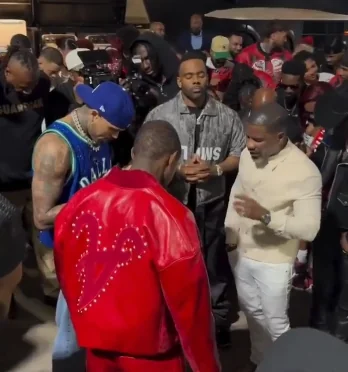
Image still from video of Kirk Franklin praying with Chris Brown, Usher Raymond, and Mario Barrett
To be clear, I fully believe that everyone is deserving of prayer. This isn’t an indictment on where Franklin stands with God for offering them prayer. I don’t personally know him, his motives for attending the show, or what was actually prayed. Likewise, I don’t know that Brown, Raymond and Barrett were honoring God or in agreement with the prayer just because their heads were bowed. But rather my questions are: As followers of Christ, are we more inclined to put ourselves in close proximity to those who have offended instead of those who have been harmed? How does it hurt our witness as believers when we routinely rush to rehabilitate the reputations of those who have offended while neglecting to care for those who are wounded?
Believers sometimes wrestle with a false dichotomy between evangelism and defending those who have experienced injustice. Jesus’ life showed that those two ideas aren’t mutually exclusive. Yes, Jesus ate with sinners, but he also never affirmed their wrongdoing. Throughout his life and ministry, Jesus regularly built community with those on the outer margins of society — the ones who were often done wrong, disadvantaged, and simply forgotten about. He valued and championed women in ways that were countercultural during his time (and in ways that sometimes remain countercultural during our time).
When a woman, who bled for 12 years and was considered unclean by society, touched Jesus’ garment and was healed, he didn’t distance himself from her or ridicule her. He stopped what he was doing and acknowledged her suffering. When he encountered the Samaritan woman at the well who had been married five times, he didn’t accuse her of any misconduct the way the modern church often does. Instead, he revealed himself to her as the Messiah and gave her the gift of salvation. When Jesus resurrected from the grave, it was women whom he first made himself known to and it was women whom he entrusted to spread the Gospel first.
It’s for these reasons that I’m deeply convinced that Jesus wouldn’t just pray for Brown. He would also be near to the men and women whom Brown has harmed. He would validate their pain.
My discomfort when seeing Franklin praying with these men wasn’t because I think being prayed for is merit-based. Instead, it was about a pattern of harmful men figuratively and literally finding refuge in “the church” to circumvent accountability. I’ve witnessed firsthand the countless times abusive men have been propped up in the church and had their sins pardoned by people they never personally wounded, while being compared to David — “a man after God’s own heart.” All the while, their victims — who are often women — are left to pick up the fragmented pieces after being physically, sexually, or emotionally abused. The demand for forgiveness and repair largely overshadows any call for accountability, justice, and correction.
God didn’t merely overlook David abusing his power to sexually assault Bathsheba or have Uriah murdered on the front line. God held him accountable and allowed him to experience the consequences of his actions. Through the prophet Nathan, God likened Bathsheba to a defenseless lamb and allowed her to conceive again after her first son died.
During his own time of stress, David wrote that the Lord is near to the brokenhearted. I do not doubt that that is true. My concern is that many who identify as followers of Christ aren’t near to the brokenhearted themselves.
And so, as the news cycle comes and goes and people soon forget about both Crockett and Franklin’s attendance at the concert, the need to support those who are wronged and pray with sinners will remain. I hope that we do away with our scarcity mindset as followers of Christ, that we can either evangelize the sinner or comfort the afflicted, but not both.
Sierra Lyons is a journalist whose work has appeared in The 19th, Teen Vogue, New York Magazine, Huffington Post, Scalawag, Sojourners, The 74 Million, NPR, and more.