

They Called It Interpretation
A reflection on Callais v. Louisiana and the long art of writing Black people out of the law
Contributor: By Mozart Dixon Jr. | The Witness BCC
I am writing this the day after the Supreme Court told Black voters, again, that the law does not quite mean what we thought it meant.
I am writing this with my coffee getting cold and my chest tight and my children in bed still. I am writing this as a Black Christian man who knows that the people who drew the Voting Rights Act into law did so with bodies still bruised from a bridge in Selma.
Today, the Court decided to forget.
In a 6-3 ruling in Callais v. Louisiana, the Court did not strike down Section 2 of the Voting Rights Act. It did something quieter and, in some ways, more cynical. It interpreted the law into near-irrelevance. It said that to prove a discriminatory voting map, you now have to prove that lawmakers intended to discriminate.
How do you prove the intent of something that has been so masterfully woven into the very fabric of a nation?
That is the point.
The American tradition of Interpretation
There is a long American tradition of making oppression legible without ever calling it by its name.
We interpreted enslaved Africans as three-fifths of a person. We interpreted Dred Scott as having no rights a white man was bound to respect. We interpreted Plessy as separate but equal. We interpreted the 15th Amendment as optional for the better part of a century while poll taxes, literacy tests, and white primaries did the dirty work the Constitution had supposedly forbidden.
In 2013, in Shelby County, the Court interpreted away preclearance.
Today, in Callais, they finished the job. Justice Kagan said the ruling "eviscerates" the law. The majority dressed that evisceration in the language of judicial modesty and walked away as if what they had accomplished would have minimal impact.
This is how empire works.
It does not always burn the covenant in the public square. Sometimes it just rewrites what the covenant means until it means nothing at all. It does not always send Bull Connor with fire hoses. Sometimes it sends six robed judges with footnotes.
The result is the same. The dignity is the same. We know our vote was diluted and it does not matter whether the person who diluted it wore a badge or a black robe. The results are the same. What was once promised is being taken away.
Where This Law Came From
It is important to remember what we are talking about when we talk about the Voting Rights Act.
It was not a gift from a wise government. It was a wound that finally became law.
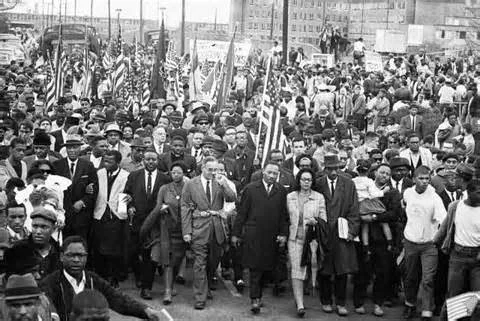
In March of 1965, John Lewis and hundreds of others walked across the Edmund Pettus Bridge to demand the right to vote. State troopers met them with billy clubs and tear gas. Lewis's skull was fractured. The nation watched it on television. Bloody Sunday. Five months later, Lyndon Johnson signed the Voting Rights Act.
That is the lineage of this law.
It was not handed down. It was dragged out. Dragged out of Congress by the determined feet of Black people who refused to stop walking, even when walking cost them their bodies.
And today, in a single paragraph, the Court undid what Bull Connor could not undo with all the dogs and fire hoses he had.
Court Rulings Are Theological Documents
At The Witness, we say often that budgets are theological documents. How money moves reveals what we truly believe about whose lives matter and whose lives do not.
The same is true of court rulings.
What a nation protects reveals what a nation worships.
When a court raises the bar of proof so high that Black voters (and many others) can no longer reach it, that court is not making a neutral procedural choice. It is making a theological claim. It is saying that the imago Dei in Black bodies does not warrant the same legal seriousness as the comfort of the people drawing the maps. It is saying that our political voice is negotiable in a way that other voices are not.
That is a confession of faith. It is the same confession that has been whispered in this country since its founding: that whiteness is the standard, that Black flourishing is optional, and that the comfort of the powerful matters more than the dignity of the disinherited.
We have heard that confession before. We do not believe it. We will not submit to it.
This Day is Precedented
I want to be careful here, because it is easy to use Scripture like a hammer when you are angry. But the Bible was written under empire. It was written by people who watched their rulers rewrite the law to protect themselves. It is not a stranger to this moment.
Amos saw rulers who trampled the poor and rigged the courts, and God called their religious gatherings noise.
Isaiah named lawmakers who wrote oppressive decrees and called them legal. He did not say God was uncertain about it. He said woe.
Mary, in her song, said God brings down rulers from their thrones.
Jesus, in his very first sermon, said he had come to set the oppressed free.
None of this is metaphor. None of this is decoration. The Gospel is not neutral about laws written to dilute the political power of the disinherited. The Gospel knows exactly what to call that. The Gospel calls it sin.
How Do WE Hold This?
I am not going to pretend I have a clean answer for today.
I do not. I am sitting with the same grief many of you are sitting with. The grief that comes when you see ANOTHER piece of hard-won ground get taken back. The grief that comes when you remember how many people bled for that ground in the first place.
So first, we grieve. Fully. Without rushing past it to find a silver lining. The grief is not weakness. The grief is faithful. It is the body refusing to lie about what just happened.
And then, we remember.
The movement that birthed the Voting Rights Act was never primarily a legal strategy. It was a spiritual practice. It was Fannie Lou Hamer saying she was sick and tired of being sick and tired. It was Ella Baker insisting that strong people don't need strong leaders. It was the church gathering before dawn to sing freedom songs and walk toward state troopers with nothing but conviction and one another.
They did not wait for the Supreme Court to bless their dignity. They knew their dignity was not on loan from a courthouse.
Neither is ours.
What Now???
The court can gut a statute. It cannot gut a covenant.
So our work continues. We tell the truth about what just happened. We refuse the gaslighting that calls this a technicality. We name the theology underneath the ruling, and we name the theology that opposes it. We build community for the people who feel the weight of this moment and need to know they are not alone in the feeling. We resource the leaders and organizers who will keep doing this work in their cities, their states, their neighborhoods, long after the news cycle has moved on.
This is the work of The Witness. Narrative. Community. Capital. Three currents of one river, all moving the way the Spirit has always been moving. Toward freedom. Toward liberation.
We are still here. Still moving. Still witnesses.
